Your odds of seeing humpback whales in Puerto Vallarta
Every winter, humpback whales travel to Banderas Bay to mate and give birth, and the boats from Puerto Vallarta go out to meet them. Nobody can promise a whale on a given morning. This guide explains what tips the odds your way and what you might see.
Why the humpbacks come to Banderas Bay
Humpback whales spend the summer feeding in colder northern water and come south for the winter. Banderas Bay, the Bahía de Banderas, gives them warm sheltered water to breed and give birth.
So the whales in the bay are not passing through in a hurry. Males compete and sing, and mothers stay with young calves, which gives boats from Puerto Vallarta a steady stream of animals to look for through the winter.
The season on the listings
The tour listings give two versions of the season. GetYourGuide listings say December to March, while Mike's catamaran on Viator says November to April. The wider range covers the edges, when fewer whales are in the bay.
In our view the middle of the winter, from late December into March, gives you the most animals to find. Our page on the best weeks for humpbacks goes into the timing, and in summer there are no humpbacks in the bay at all.
What a sighting can look like
A sighting is rarely one big leap. Most of the time you see whales breathing and diving, and the more dramatic moments come in between. These are the things the crews point out most.
- The blow, a burst of mist when a whale breathes out at the surface
- The tail, or fluke, lifting clear of the water as a whale dives
- A long pectoral fin raised or slapped on the surface
- A breach, when a whale throws most of its body into the air
- A mother swimming slowly with her calf
- Dolphins on some trips; the Live & Travel Tours listing names dolphin watching
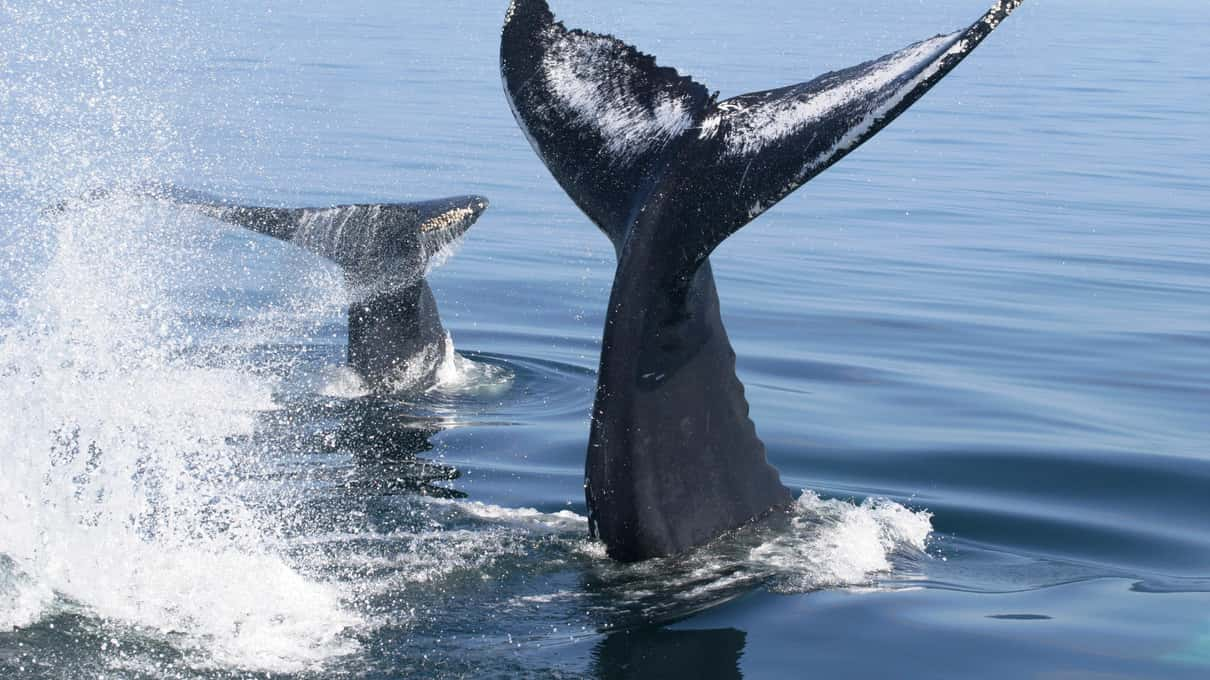
The blow is usually the first clue. On a still morning it can hang in the air long enough for the whole boat to turn and look, and the crew then judges where the whale will come up next.
Groups of males chasing a female can be the liveliest sight of all, with splashing and sudden surfacing. A mother and calf are quieter, but watching a young whale learn to breathe beside its mother stays with many people.
None of these is promised on any trip. A whale that dives deep can stay down for a while, and the crew may wait or move on to another blow on the horizon.
What "guaranteed" means on Los Veranos
The Los Veranos trip at ~$99 carries the name "Whale Watching Guaranteed Experience". It runs 3 hours on fast APEX boats and rates 4.9 from 100+ reviews on Viator and 5.0 from 8 on GetYourGuide.
The listings we read do not spell out what happens if no whale shows up, whether that is a refund, a second trip or something else. Ask the operator before you book, and keep the answer in writing.
A fast boat does improve your chances of reaching whales spotted far away. The trade is a shorter trip, so you spend less time watching each group once you find it.
The trip that puts a promise in its name
Los Veranos covers the bay quickly on high-speed boats, with transportation and a box lunch included. Confirm the guarantee's terms with the operator first.
How close the boats can go
Mexico regulates whale watching closely, from the distance a tour boat keeps to the minutes it may spend beside one group. The aim is to keep the whales from being crowded, above all mothers with young calves.
So a good sighting often happens at a respectful distance, and a whale that chooses to come nearer is a bonus. A camera with a zoom helps, and our packing list for the boat covers the rest.
Humpbacks know nothing of these rules, and a curious whale sometimes surfaces beside a boat that has stopped its engine. When that happens the crew should stay put and let the whale decide when to leave.
Those limits also explain why boats spread out across the bay instead of crowding one group. If another boat is already with a whale, your captain may look for a different one rather than queue.
Ways to tilt the odds
You cannot control the whales, but a few choices help. Book in the middle of the winter rather than at the edges, and pick a longer trip if you want more time on the water.
A boat with a biologist knows where to look and what the whales are likely to do next. Our guide to the biologist-led trip explains that, while a fast boat reaches distant blows sooner, as our comparison of the boat types shows.
Morning water is often calmer than the afternoon, which makes blows easier to spot on a flat surface. That is a general pattern, not a rule, and a breezy morning still happens.
Patience helps more than people expect. Spend the trip scanning the horizon instead of your phone, and call out any blow you see, since the crew cannot watch every direction at once.
If the sea or the whales let you down
On rough days the port can close, and the trip is called off. You can usually cancel for free until a day before, and an operator cancellation should bring a refund or a new date, but check the policy on your listing.
Booking early in your stay leaves room for a second try. Our price guide compares what each fare includes, and our page on rough water and cancellations covers the weather side in more detail.